
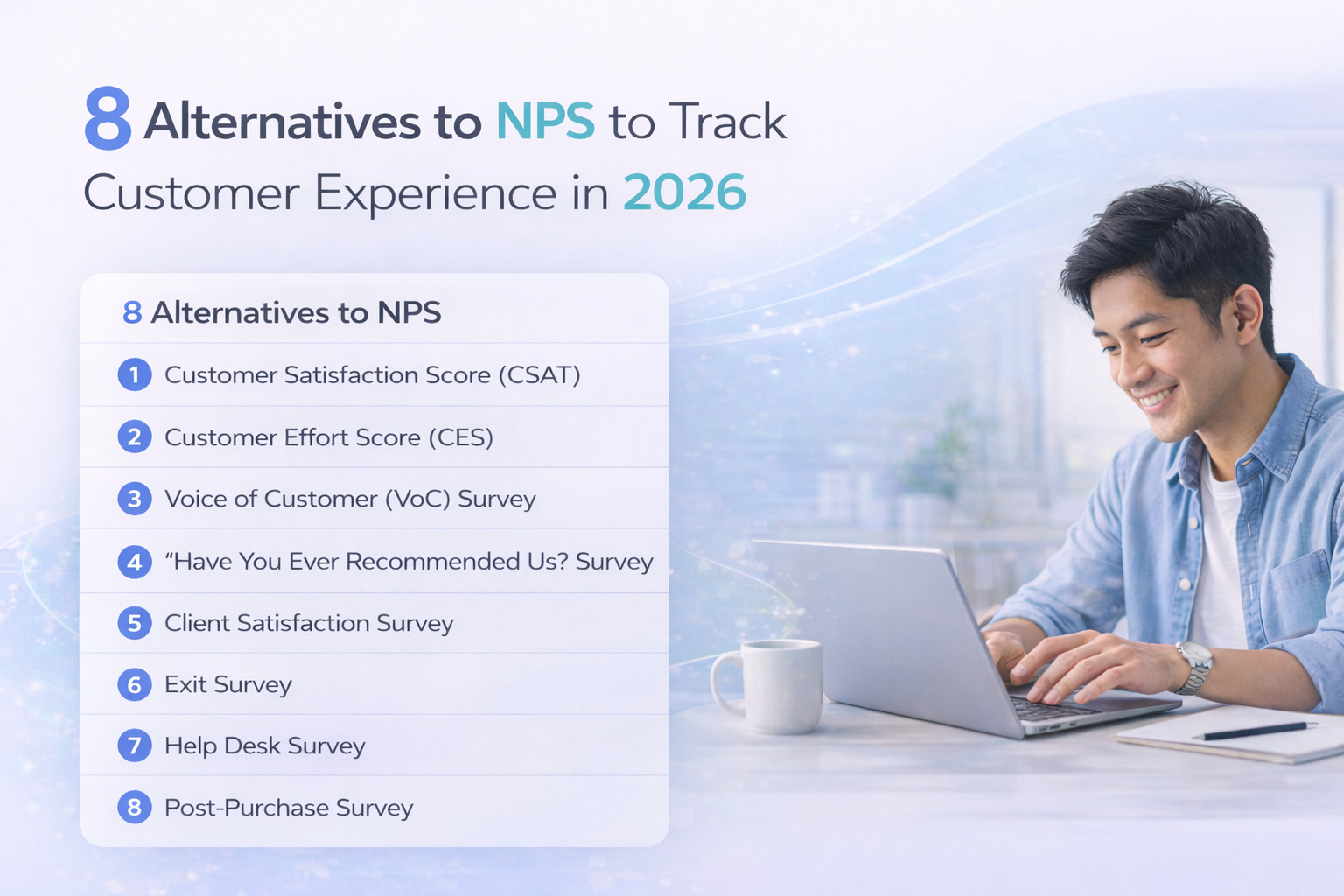
8 Alternatives to NPS to Track Customer Experience in 2026
NPS has one job: give you a number that represents customer loyalty. It does that job reliably. What it doesn't do is tell you what's behind the number.
A score of 32 could mean your onboarding is frustrating. It could mean a competitor is circling. It could mean one support channel is quietly damaging relationships across hundreds of accounts. You don't know until you dig through the open-ended responses, and by then, the moment to act has usually passed.
That's what's driving the search for alternatives to NPS. Not to throw out measurement, but to get feedback that's tied to specific moments, faster to act on, and easier to explain to stakeholders than a single shifting number.
Here are 8 worth knowing.
Why Look for Alternatives to NPS?
NPS isn't broken, but it has real limitations worth naming:
- It's a lagging indicator. NPS reflects how customers felt about the past. By the time your score drops noticeably, churn may have already started.
- It asks about hypothetical behavior. Whether someone would recommend you is different from whether they do. Intent and action don't always line up.
- It offers no diagnostic information. A score of 40 versus 55 signals that something changed, but not what changed, where it happened, or which customer segment is responsible.
- Response bias skews results. Customers at the emotional extremes — very happy or very unhappy - are most likely to respond. The moderate majority stays quiet.
- It treats all customers equally. A churned enterprise account and a new free-trial user both count the same toward your score, even though their feedback should carry very different weight.
None of these are arguments against measurement — they're arguments for measuring at the right moments, with the right questions.
1. Customer Satisfaction Score (CSAT)
CSAT is the most widely used alternative to NPS, and one of the most immediately actionable.
A CSAT survey asks a simple question:
"How satisfied were you with [this experience]?"
Customers respond on a scale, typically 1 to 5 — and you calculate your score as the percentage of respondents who selected 4 or 5.
What makes CSAT particularly useful is that it's tied to a specific interaction rather than the overall relationship.
If satisfaction dips after a product update or a particular support interaction, you know exactly where to investigate.
Best for: Post-support resolution, post-purchase moments, onboarding check-ins, any touchpoint where you want immediate feedback on how an experience landed.
Limitation: CSAT is transactional by nature. A high score after one support ticket doesn't tell you whether that customer is likely to renew. It works best as part of a broader feedback program, not as a standalone substitute for NPS.
2. Customer Effort Score (CES)
Customer Effort Score measures how much effort a customer had to put in to complete an interaction with your company.
The CES question typically looks like:
"How easy was it to [resolve your issue / complete your purchase / get started]?"
Customers respond on a 5 or 7-point scale from "Very difficult" to "Very easy."
Many CES surveys follow up with an open-ended question, "What made this difficult?" — to give context to the score.
Gartner research found that reducing customer effort is one of the strongest predictors of loyalty and repurchase. Customers with low-effort interactions are significantly more likely to stay, expand, and recommend, which makes CES a valuable early-warning signal for churn risk.
Best for: Post-support interactions, self-service flows, onboarding steps, checkout experiences, and any moment where friction is a known risk.
Limitation: CES measures a moment, not a relationship. It won't give you a read on long-term sentiment or overall account health.
3. Voice of Customer (VoC) Survey
Voice of Customer surveys take a different approach to NPS entirely. Rather than a single standardized question, they let you ask customers about their needs, preferences, and expectations in whatever format is most useful for your team.
A VoC survey can combine an NPS-style rating question with Likert scale questions, open-ended responses, and ranking questions, all in one survey. This makes it one of the most versatile tools for capturing a comprehensive view of the customer experience at a given point in time.
Because VoC surveys are highly customizable, they're particularly useful when you're trying to understand why customers feel a certain way, not just how much they feel it.
Best for: Quarterly customer pulse checks, post-onboarding research, product feedback cycles, and any situation where you want to go deeper than a single metric allows.
Limitation: Longer surveys mean lower completion rates. Keep VoC surveys focused, ask only what you'll actually act on.
4. "Have You Ever Recommended Us?" Survey
This is a direct evolution of the NPS premise, but instead of asking whether someone would recommend you, it asks whether they have.
The question is simple:
"Have you ever recommended [Company] to a friend or colleague?"
If the answer is no, follow-up questions explore why. If the answer is yes, follow-up questions help you understand what drove the referral and how to create more of those moments.
This survey type gives you a more honest read on word-of-mouth impact because it's grounded in actual behavior rather than stated intent. Customers who say they've already recommended you are far more reliable loyalty signals than customers who say they might.
Best for: Quarterly loyalty measurement, referral program analysis, understanding what's actually driving (or blocking) organic growth.
Limitation: This survey works best with established customers who have had enough time to potentially refer someone. It's less useful for new customers or early in the relationship.
5. Client Satisfaction Survey
For teams working in B2B or on longer-term client relationships, a structured client satisfaction survey gives you a richer picture than any single-metric survey can.
A well-designed client satisfaction survey typically combines:
- A rating or NPS-style question on overall relationship health
- Scale questions on specific dimensions: communication, responsiveness, product quality, value for money
- A ranking question to surface which aspects of the relationship matter most to the client
- An open-ended question for anything they want to share
Sending this survey on a regular cadence, quarterly for key accounts, semi-annually for others, builds a view of relationship health over time and helps CS teams identify accounts that are drifting before they escalate.
Best for: B2B and professional services companies managing ongoing client relationships, especially where account health and renewal risk are a priority.
Limitation: Keep it concise. Surveys that exceed 5–6 questions see noticeably lower completion rates. If you need broader coverage, split questions across different touchpoints rather than front-loading a single long survey.
6. Exit Survey
No feedback is more honest than the kind that comes from a customer who's already decided to leave.
An exit survey is sent, ideally automatically, at the moment a customer cancels or downgrades. It asks why they're leaving, gives them space to elaborate, and optionally asks what would have changed their mind.
The data from churn surveys is uniquely valuable because it's a confirmed truth, not a prediction. It tells you the actual reasons customers left, not the reasons you suspect based on usage signals or score trends. Teams that consistently analyze churn responses often surface patterns invisible elsewhere, a specific competitor win narrative, a recurring product gap, or a pricing concern that never appeared in regular satisfaction surveys.
Best for: SaaS, subscription businesses, and e-commerce — any business model where churn is a core metric and understanding its drivers is a strategic priority.
Limitation: Response rates are typically low. Customers who've already decided to leave have little incentive to explain themselves. Keeping the survey to 2–3 questions and making it effortless to complete will maximize the signal you capture.
7. Help Desk Survey
The help desk survey fills a gap NPS can't: measuring the quality of support interactions in real time.
A help desk survey is sent immediately after a support ticket is resolved. It typically asks how satisfied the customer was, whether their issue was fully resolved, and optionally invites them to share any additional feedback.
Tracking help desk scores over time helps support leaders monitor team performance, identify recurring issue categories, and catch drops in support quality before they show up in overall satisfaction scores. Because it's tied to a specific, recent interaction, the feedback is almost always more useful than a periodic NPS survey.
Best for: Support teams, customer success operations, and any team that wants a continuous quality signal on help desk performance.
Limitation: Help desk surveys measure one touchpoint in the customer journey, the support interaction, not the overall relationship. They're most valuable when combined with other metrics like CSAT or NPS to build a complete picture.
8. Post-Purchase Survey
For e-commerce and product companies, the post-purchase moment is one of the highest-leverage feedback opportunities in the customer journey.
A post-purchase survey asks customers about their recent purchase experience: how easy it was to place the order, how they feel about the price, how the delivery met their expectations, and what (if anything) could have been better.
Send it immediately after purchase, while the experience is fresh. Customers are primed to reflect in that moment, which means you'll get higher-quality responses than any periodic survey can match. The insights can improve checkout flows, delivery expectations, packaging, and product descriptions in ways that NPS alone could never surface.
Best for: E-commerce, D2C brands, and any business where the purchase experience is a key driver of retention and repeat buying.
Limitation: Post-purchase surveys are transactional by design. They tell you about the purchase experience, not long-term satisfaction, loyalty, or the likelihood of return.
Find Your NPS Alternative with Elvan
The best CX programs don't rely on a single metric.
They layer CSAT and CES at key touchpoints, run VoC surveys to understand the "why," use churn surveys to confirm what the signals suggested, and track post-purchase feedback to optimize the moments that drive repeat revenue.
The challenge is bringing all of that together without it becoming a full-time job.
Elvan is an AI-powered survey platform that lets CX teams, product managers, and HR leaders run NPS, CSAT, CES, and custom surveys from one place, and understand what the responses mean without manually reading every comment.
Elvan's AI automatically surfaces themes from open-ended responses, flags early warning signals, and delivers leadership-ready summaries. Instead of "140 open-ended comments," you see "34% mentioned onboarding friction" and "21% cited slow support response times."
Launch fully branded surveys via email, JavaScript SDK, or web link in minutes. No complex builders. No lengthy implementation. Just fast, clear customer signals your team can actually act on.
Ready to move beyond NPS? Start free with Elvan →

Neil Roy
Content Strategist
Neil is a content strategist specializing in CSAT and NPS surveys, creating educational content that helps businesses understand and improve customer satisfaction. With 10+ years of experience, Neil writes insightful articles and develops content strategies that translate complex survey concepts into accessible, actionable guidance for organizations looking to enhance their customer relationships and business outcomes.