

Why Survey Response Rates Are Falling (And What Still Works in 2026)
Survey response rates are falling because the channel most teams rely on, email, has quietly stopped working. The inbox is crowded, attention is short, and a link asking someone to leave their app, load a page, and reconstruct context for an interaction they already moved on from is a hard sell in 2026. The decline is real. But it is not happening evenly across every channel, and the teams getting fewer responses are usually the ones still doing the same thing they did in 2021.
Here is what the 2025 data actually shows, and where the responses are still coming from.
The numbers behind the decline
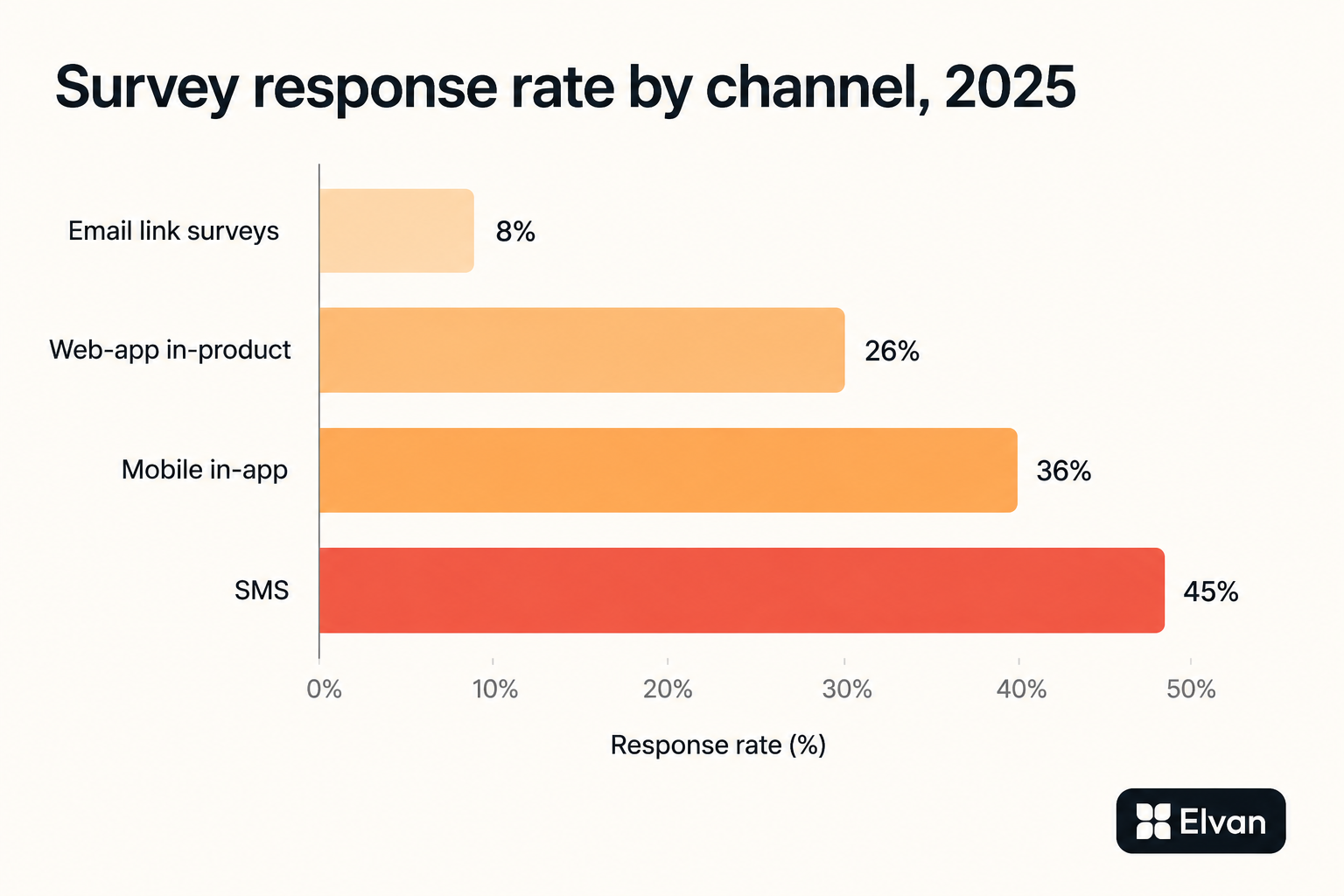
Across all channels, the average customer survey response rate in 2025 sat somewhere around 20 to 30 percent, depending on whose dataset you read. That headline number hides the real story. The spread between the best channel and the worst is now enormous, and email is sitting at the bottom of it.
Retently's 2025 analysis of ecommerce survey programs put email response at roughly 3 percent and in-product surveys at roughly 32 percent. That is close to a tenfold gap between two ways of asking the same person the same question. Their read on it is worth repeating. The problem is not that people hate giving feedback. The problem is that the inbox has lost its ability to turn attention into action on its own.
Public benchmarks point the same direction. Email surveys generally land between 15 and 25 percent when they are well targeted and personalized, and far lower when they are not. B2B email NPS often averages around 12 percent. In-app and in-product surveys regularly clear 25 to 35 percent. SMS sits higher still.
So the decline is channel-specific. If your response rate has dropped over the last two years and you are still sending email blasts, the channel is most of your problem.
Why the inbox stopped converting
Email survey invites depend on a click. The recipient has to open the email, want to click, and then follow through on a separate page. Every one of those steps has gotten harder.
Zeta's 2025 email benchmark showed click-to-open rates declining across most verticals. For retail specifically, conversion to click slipped from 15.6 percent to 14.6 percent year over year. Survey invites are a click ask. When click behavior is under pressure across the board, the ceiling on email survey response drops with it, even if your questions, timing, and copy never changed.
There is also fatigue. People get surveyed constantly now. The NPS request after a support ticket, the CSAT after a purchase, the product feedback after a feature launch. By the time your email lands, the customer has already declined three others that week.
None of this means stop asking. It means stop assuming the inbox will carry the ask for you.
What still works: channel beats copy
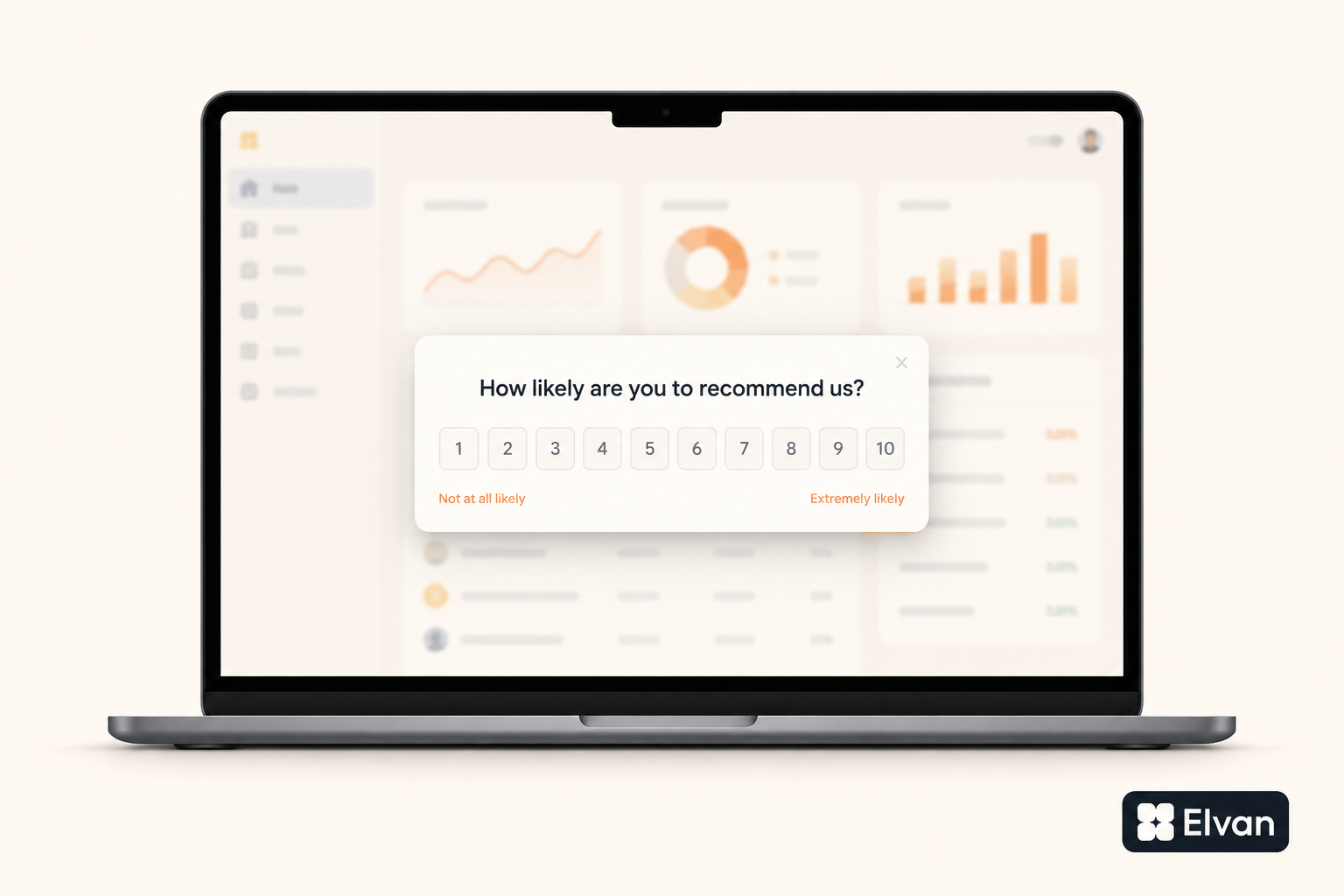
The single highest-return change most teams can make is moving the survey closer to the moment that matters. In-product surveys, the kind shown to someone while they are actively using your product, remove the friction email cannot escape. No new tab. No lost context. The question appears where the experience is happening.
Refiner's 2025 in-app study found mobile app surveys averaging 36 percent response and web-app surveys averaging 26 percent. Placement mattered almost as much as channel. A modal in the center of the screen pulled around 43 percent, while surveys tucked into a corner got far less. Same survey, different spot, double the response.
The lesson is blunt. You can spend a week rewriting subject lines and intro copy, or you can change where the survey fires. The second one moves the number more.
Timing is the other half
A survey is most likely to get answered right after the thing it is asking about. Research cited across 2025 benchmarks found that surveys sent within two hours of an event get around 32 percent more completions than surveys sent later. Wait three days and you are asking someone to remember how they felt, which is both lower response and worse data.
This is why batch email surveys underperform. A weekly or monthly send treats every customer as if they are at the same point in their journey. They are not. The customer who just finished onboarding, the one who just had a ticket resolved, and the one who just hit a usage milestone each need a different question at a different moment. Trigger on the event, not the calendar.
Length still decides completion
The data on length is consistent and unforgiving. Most people finish a survey in under two minutes, and Survicate's 2025 benchmark put the median completion time at roughly 114 seconds. Past that, response and completion rates fall off.
NPS and CSAT survive the length problem because they start with a single question. One number, then an optional comment. The teams seeing strong response are not the ones with the most questions. They are the ones who ask one good question at the right moment and stop there.
What this means for your feedback program
Pull the threads together and the playbook for 2026 is clear. Match the channel to where your customers already are, which for most digital products means in the product, not the inbox. Fire on the event, not the schedule. Keep it to one core question. Treat email as one channel among several, not the whole program.
This is the part where most teams hit a wall. The tools that make in-product, event-triggered surveys easy have historically been priced for enterprise, or they require a developer to wire up the triggers. That is the gap Elvan was built to close.
Elvan runs NPS, CSAT, CES, eNPS, and PMF surveys across five channels, including a Web SDK that fires in-product after any event you define. No developer needed, and setup takes under 20 minutes. You can trigger a CSAT the moment a Zendesk ticket closes, an NPS after a key milestone inside the product, or a post-purchase survey that lands while the experience is still fresh. The AI Insights feature then turns the responses into a plain-English summary, so a Head of CS can walk into a QBR with a clear read on what changed and why, without a data team.
It is free up to 100 responses a month, and 49 dollars a month after that. The whole point is to make the thing the data says works, in-product surveys triggered at the right moment, something a small team can actually run.
Falling response rates are not a reason to survey less. They are a signal that the old channel stopped doing the work. Move the ask to where your customers are, and the responses come back.
See how in-product surveys change your response rate: elvan.ai/nps-software

Neil Roy
Content Strategist
Neil is a content strategist specializing in CSAT and NPS surveys, creating educational content that helps businesses understand and improve customer satisfaction. With 10+ years of experience, Neil writes insightful articles and develops content strategies that translate complex survey concepts into accessible, actionable guidance for organizations looking to enhance their customer relationships and business outcomes.