

How to Close the Feedback Loop (And Why 90% of Teams Don't)
Here is the part nobody tells you when you launch your first NPS survey. The score is not the hard part. Sending the survey is not the hard part. The hard part is what happens after a customer hits submit and tells you something is wrong.
Most teams do nothing. The response lands in a dashboard, someone glances at the number, and the customer who took thirty seconds to give you honest feedback never hears back. That silence has a cost. The next time you ask, they do not answer. Response rates fall. Your data gets thinner and more biased with every cycle, until the only people still replying are the ones who already love you.
This is the feedback loop, and closing it is the single most underrated skill in customer experience. Let me walk through what it actually means, why so few teams do it, and how a small team can do it without hiring anyone.
What "closing the loop" actually means
The phrase gets thrown around loosely, so let me be precise. Closing the feedback loop means responding to the person who gave you feedback, taking action on what they said, and telling them what changed because of it. Three steps. Most teams stop after step zero.
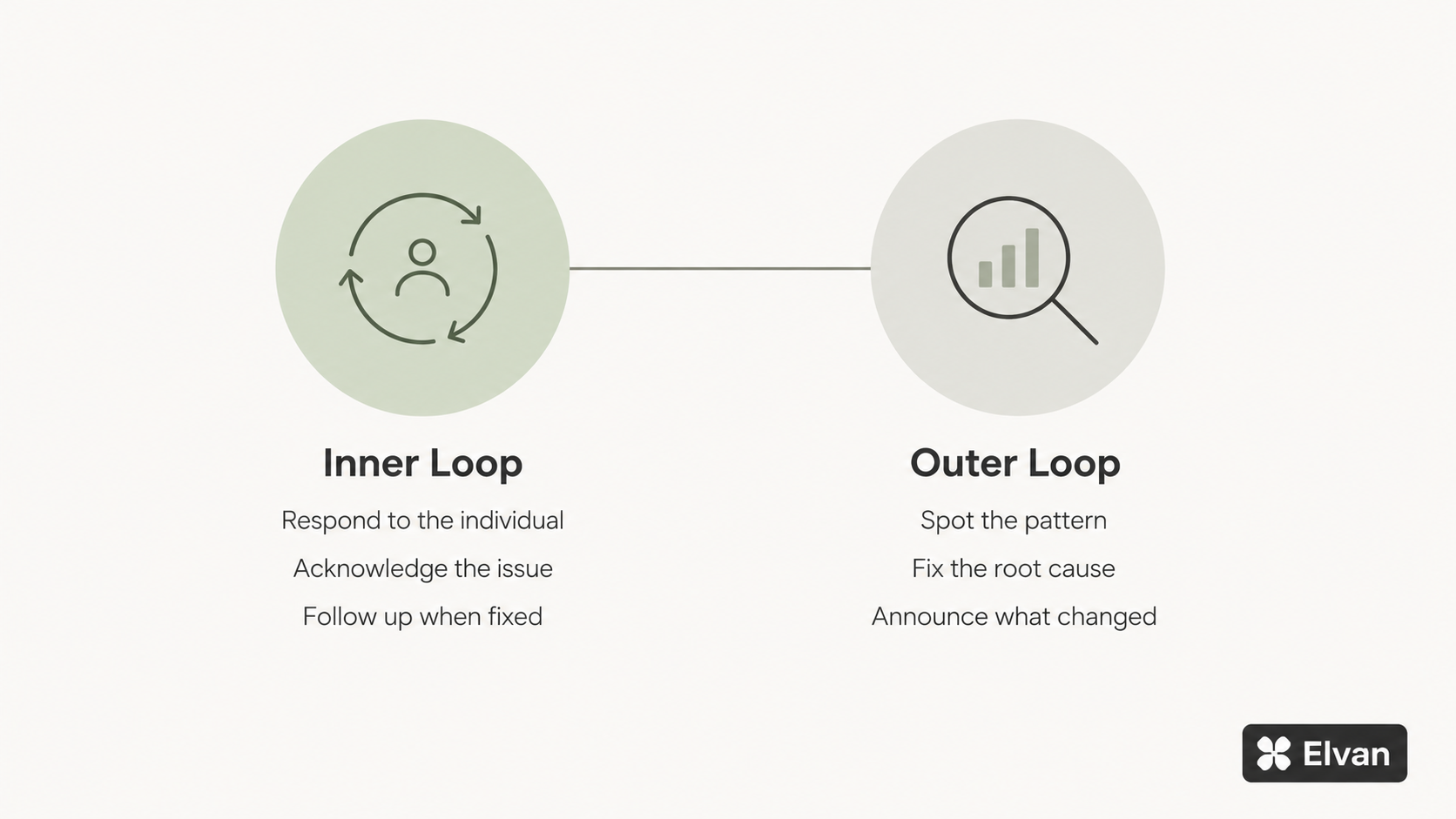
There is an inner loop and an outer loop, and you need both.
The inner loop is the individual response. A customer rates you a 4 out of 10 and writes "the export feature is broken on mobile." Closing the inner loop means someone reaches out to that specific person, acknowledges the problem, and follows up when it is fixed. It is personal. It is one to one. It is the difference between a detractor who churns and a detractor who becomes one of your loudest advocates because you actually listened.
The outer loop is the systemic response. Forty people mention the same broken export feature over a quarter. Closing the outer loop means that pattern reaches your product team, gets prioritized, ships, and then you announce it back to everyone who raised it. The inner loop saves the relationship. The outer loop fixes the root cause so the same complaint stops showing up.
A team that only runs the inner loop is doing customer service. A team that only runs the outer loop is doing product research. Closing the loop properly means doing both, and connecting them.
Why 90% of teams never do it
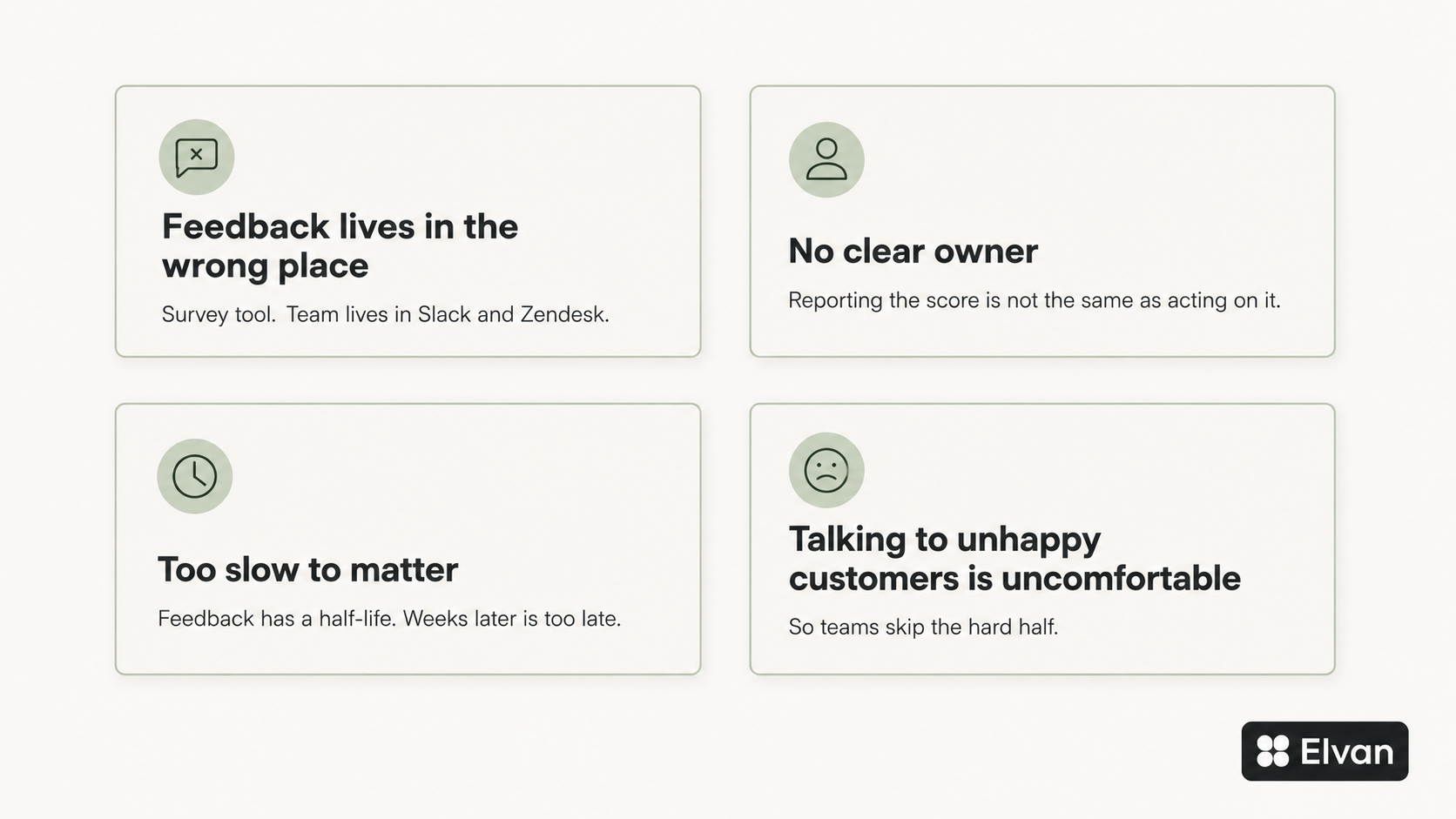
It is not laziness. It is structural. Four reasons come up again and again.
The first is that the feedback lives in the wrong place. The survey tool collects responses, but the people who could act on them live in Zendesk, in Slack, in the product roadmap, in the sales CRM. If closing the loop requires someone to log into a separate dashboard, export a spreadsheet, and manually route each comment, it will not happen at any real volume. The friction is fatal.
The second reason is that there is no owner. NPS gets reported in a monthly deck, the number goes up or down, everyone nods, and nobody is responsible for the individual detractor who said they were about to leave. Reporting a score and acting on a score are different jobs, and most teams only staff the first one.
The third reason is timing. By the time a quarterly NPS sweep gets analyzed, the customer who flagged a problem has moved on, cooled off, or already cancelled. Feedback has a half-life. A frustrated comment is worth ten times more in the hour after it is written than it is three weeks later in a board slide.
The fourth reason is the one people admit least often. Closing the loop means talking to unhappy customers, and that is uncomfortable. It is easier to celebrate the promoters than to call the person who gave you a 3 and ask what went wrong. So teams quietly skip the hard half.
None of these are problems of effort. They are problems of setup. Which is good news, because setup is fixable.
The compounding cost of an open loop
Skip closing the loop once and nothing visibly breaks. That is the trap. The damage shows up later and it compounds.
Start with response rates. When customers see that feedback goes into a void, they stop giving it. Industry research on survey fatigue is consistent on this point: perceived responsiveness is one of the strongest drivers of whether someone answers your next survey. Ignore people once and a meaningful share will not answer again. Your sample shrinks. And it does not shrink randomly. The customers who give up first are often the ones in the messy middle, the passives and mild detractors, exactly the group whose feedback you most need to prevent churn. What you are left with is a dataset skewed toward the already happy, which makes your score look better while telling you less.
Then there is the churn you never see coming. A detractor who feels heard frequently stays. A detractor who feels ignored confirms the decision they were already leaning toward. The open loop does not just fail to save the relationship. It actively accelerates the exit, because now they have evidence that you do not care.
And there is the opportunity cost on the product side. Every unclosed outer loop is a pattern you paid to collect and then threw away. You ran the survey, you spent the response, and the insight never reached the person who could have acted on it. That is the most expensive kind of waste, because it looks free.
Closing the loop reverses all of this. Responsiveness lifts the next response rate. Saved detractors lift retention. Patterns that reach the roadmap lift the product. None of these are one-time gains. They build on each other every cycle, which is why teams that close the loop pull away from teams that do not.
How a small team closes the loop without hiring
Here is the practical part. You do not need a CX analyst or a research function. You need three things wired together: feedback that arrives at the moment of truth, feedback that lands where your team already works, and a fast way to know what to act on first. This is exactly what Elvan was built to do.
Catch feedback at the moment, not weeks later
The inner loop only works if you reach the customer while the experience is fresh. A quarterly email blast cannot do that. Triggered, in-context surveys can.
Elvan gives you five distribution channels, and the two that matter most for loop-closing are the Web SDK and the native Zendesk integration. The Web SDK is a lightweight snippet that fires a survey inside your product right after a specific event: a project launched, a feature used, an onboarding step finished. You are asking the customer how it went seconds after it went, not three weeks later in a batch you scheduled and forgot. The Zendesk integration is even more direct. When a support ticket is marked resolved, Elvan automatically sends a CSAT survey, immediately or after 24 hours, your choice. The moment a customer's problem is handled is the moment to ask if it was handled well. That timing is the whole game.
Every Elvan survey is two questions maximum. That is a deliberate choice, not a limitation. Short surveys get answered, and a loop you can actually close beats a long questionnaire nobody finishes.
Put the response where your team will see it
Feedback that sits in a separate tool does not get acted on. Feedback that shows up in the flow of work does.
Because Elvan connects natively to Zendesk and Slack, a low CSAT score or a sharp NPS comment can surface where your team already lives. The person who can fix the problem sees the problem without logging into anything new. That removes the single biggest source of friction in the whole process, the one that quietly kills loop-closing at almost every company. No export. No manual routing. No spreadsheet.
Know what to act on first
Volume is the enemy of action. Fifty responses land and the team freezes, unsure where to start, so they start nowhere.
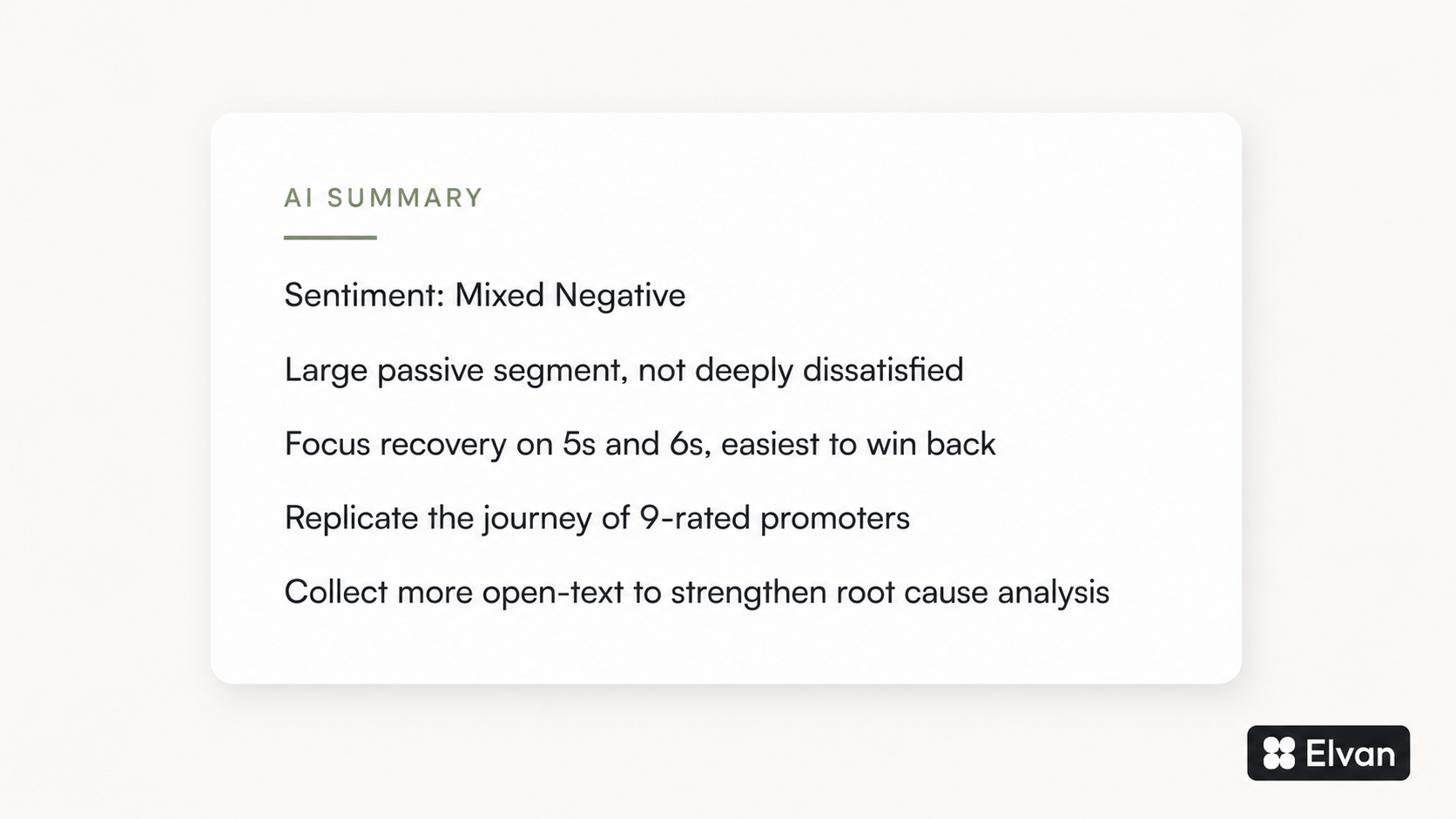
This is where Elvan's AI Insights earns its place. Instead of handing you a raw export, it reads the responses and tells you in plain English what happened, why it likely happened, and what to do next. A real summary from the product looks like this: sentiment is mixed negative, the score is being dragged down by a large passive segment rather than angry detractors, the fastest recovery is to work the 5s and 6s because they are the easiest to win back, and you should collect more open text because only a fraction of respondents left comments. That is not a dashboard. That is a prioritized action list. It is the difference between a Head of CS who exports a CSV and one who walks into the quarterly review with a clear story and a plan, looking like they have a data team behind them when it is just them and Elvan.
When you can see what to do first, closing the loop stops being a project and becomes a habit.
Start with the inner loop this week
You do not have to fix everything at once. Pick the highest-intent moment you have, the support ticket resolution or the key in-product action, and put a two-question survey there. When a response comes in below your bar, reach out to that person the same day. Acknowledge it. Fix what you can. Tell them when it is done.
Do that consistently for a month and two things happen. The customers you reach remember it, because almost no company does this. And your next response rate goes up, because word gets around that feedback to you actually goes somewhere.
That is the loop closing. It is not complicated. It just has to actually happen, and it has to happen fast enough to matter.
Elvan is built for exactly this: triggered surveys at the moment of truth, responses that land where your team already works, and AI summaries that tell you what to act on first. Free to try, set up in under twenty minutes.

Neil Roy
Content Strategist
Neil is a content strategist specializing in CSAT and NPS surveys, creating educational content that helps businesses understand and improve customer satisfaction. With 10+ years of experience, Neil writes insightful articles and develops content strategies that translate complex survey concepts into accessible, actionable guidance for organizations looking to enhance their customer relationships and business outcomes.