

What Is a Good Customer Effort Score? 2025 Guide, Examples & Benchmarks
Customer Effort Score (CES) has quickly become one of the most important metrics for businesses looking to improve customer satisfaction and foster loyalty.
It reveals how easy or difficult it is for customers to interact with a brand across all touchpoints. Measuring how hard customers have to work for solutions lets companies pinpoint friction, streamline service, and drive growth.
What Is Customer Effort Score?
CES is a customer experience metric that quantifies the effort required for customers to resolve issues, make purchases, or receive support.
Typically, companies collect this data through a simple survey after an interaction, asking for a response on a scale (commonly 1-5 or 1-7).
A higher CES reflects a smoother, low-effort experience, while a low CES signals customer frustration or friction.
Why Does CES Matter?
- Strong linkage to loyalty: Businesses providing effortless experiences retain more customers and inspire higher spending.
- Predictive of churn: A high-effort service interaction makes customers up to 96% more likely to leave or share negative feedback.
- Actionable insights: CES surveys uncover issues that other metrics (NPS, CSAT) may miss, spotlighting practical fixes that drive satisfaction.
How Is Customer Effort Score Measured?
CES Survey Question Formats
- “How easy was it to resolve your issue with us today?”
- “The company made it easy for me to solve my problem.” (Agree/Disagree)
- Numeric scale (1–5, 1–7) or percentage agree.
Responses are usually averaged to produce a CES score for individual touchpoints or periods. Some companies use a Likert scale with color-coded options for clarity and instant feedback.
Best Practices for Administering CES Surveys
- Send CES questions immediately after key interactions (e.g., order support, product onboarding).
- Tailor the question language to match the nature of the customer journey.
- Keep questions focused, avoid stacking multiple metrics or objectives in a single survey.
What Is a Good Customer Effort Score?
Interpreting Your CES Scores
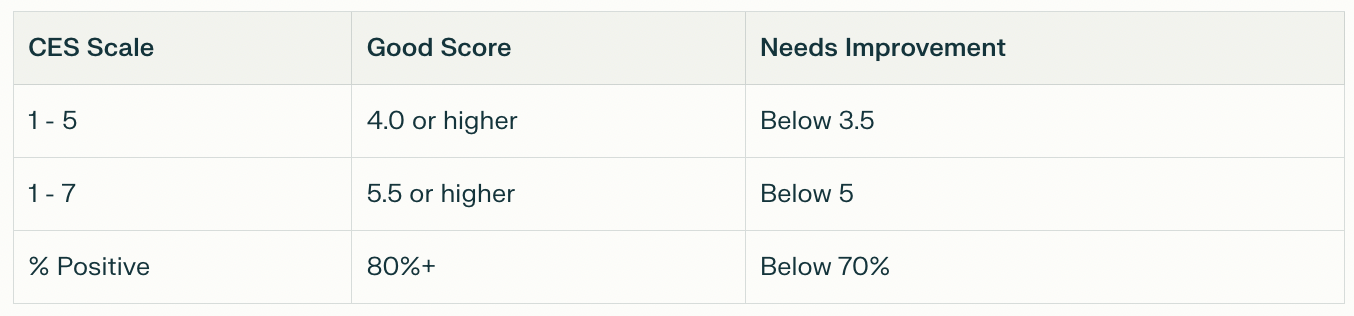
- 1–5 scale: A score of 4 or above is excellent; below 3.5 signals significant barriers.
- 1–7 scale: Scores of 5.5+ are strong; below 5 means room to improve experience.
- % positive responses: Anything above 80% is healthy, 90%+ is best-in-class.
CES Benchmarks by Industry & Company Size
Industry and company size shape what a “good” CES looks like:
- SaaS/Technology: 85–90% positive ratings; streamline onboarding and support.
- E-commerce/Retail: CES can range between 5.1 (electronics) and 5.4 (fashion) on a 7-point scale.
- Enterprise/B2B: Personalized service often drives higher CES; large organizations should focus on minimizing data repetition and channel switching.
- Small business: Direct support can push CES above industry norms, but scalability requires consistent processes.
Benchmark frequently to track progress and uncover areas for improvement specific to your business landscape.
Designing Effective CES Questions (With Examples)
Crafting clear CES questions is essential for actionable feedback:
- “On a scale of 1–7, how easy was it to interact with our company?”
- “Was your problem resolved with minimal effort?”
- “How satisfied are you with the ease of service today?”
Combine simple rating questions with optional open-ended follow-ups (“What could we have done to make it easier?”) for deeper insight.
CES vs. Other Customer Experience Metrics
CES stands alongside CSAT (Customer Satisfaction Score) and NPS (Net Promoter Score), but it adds unique value:
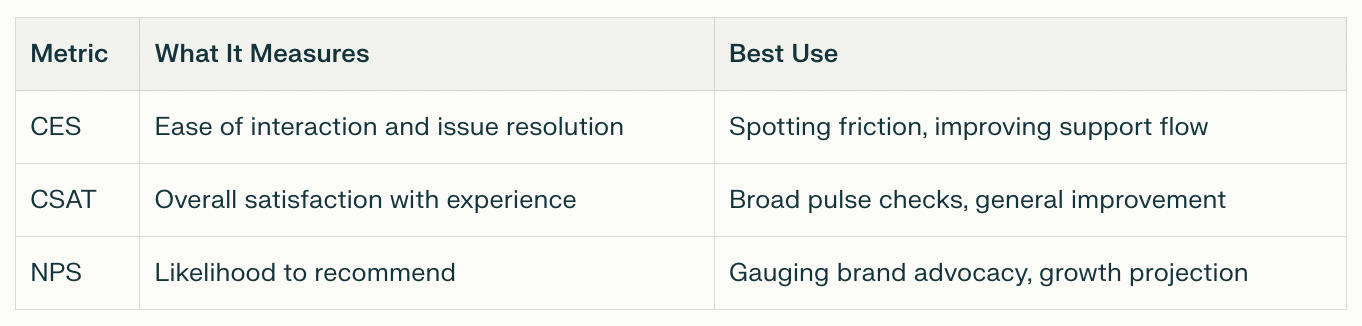
Research shows CES predicts both repurchases and spending intent more accurately than NPS or CSAT, especially in service/support contexts.
How To Improve Your Customer Effort Score
Practical Strategies
- Minimize steps: Streamline checkout, account creation, or support flows.
- Empower support teams: Train agents to resolve issues on first contact and reduce transfers.
- Self-service tools: Offer robust FAQs, help docs, and chatbots for instant assistance.
- Analyze friction points: Use CES results to uncover specific pain points, then iterate.
Implement changes, then regularly survey customers to verify progress and celebrate improvement.
Optimizing CES Polls for Maximum Insight
- Align CES with operational metrics: Connect CES results to first contact resolution (FCR), turnaround time (TAT), and complaint rates.
- Segment results: Compare CES scores by channel (chat, phone, email) for targeted fixes.
- Visualize trends: Track CES over time to predict churn or spot seasonal patterns.
- Link to retention: Use CES improvement campaigns as part of broader loyalty strategy.
Conclusion
Customer Effort Score is the go-to metric for measuring and optimizing customer experience. Aim for scores above 80% positive, 4+ on a 5-point, and 5.5+ on a 7-point scale for an experience customers love.
With regular benchmarking, targeted improvement, and smart question design, CES will become a cornerstone of customer-centered business growth.

Neil Roy
Content Strategist
Neil is a content strategist specializing in CSAT and NPS surveys, creating educational content that helps businesses understand and improve customer satisfaction. With 10+ years of experience, Neil writes insightful articles and develops content strategies that translate complex survey concepts into accessible, actionable guidance for organizations looking to enhance their customer relationships and business outcomes.