
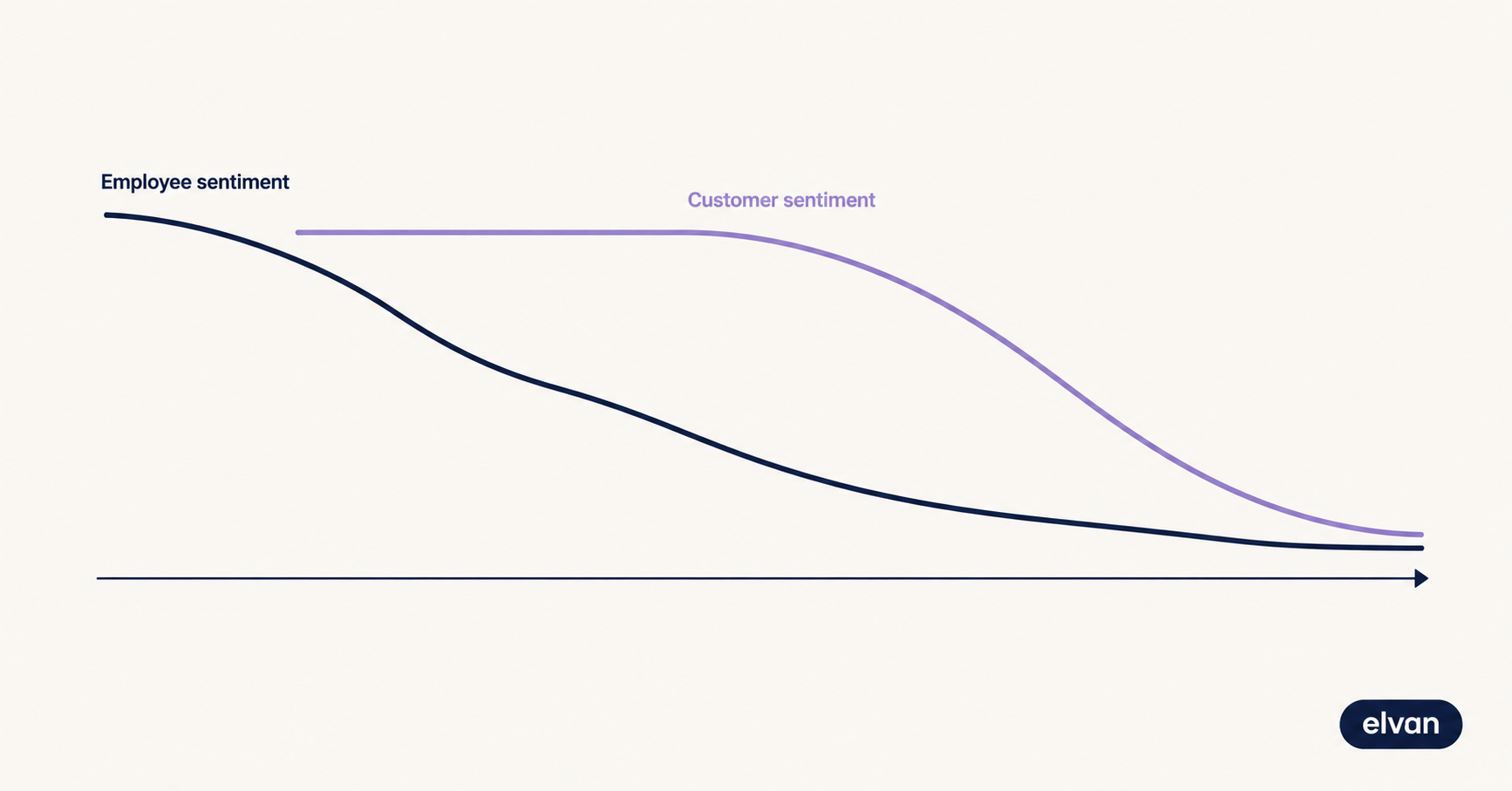
ENPS: What to Do When Your Employees Trust You Less Than Your Customers
ENPS, or Employee Net Promoter Score, asks one question: how likely are you to recommend this company as a place to work, on a scale of 0 to 10. The math is identical to customer NPS. Scores of 9 or 10 are promoters, 0 through 6 are detractors, 7 and 8 are passives excluded from the subtraction. Subtract the detractor percentage from the promoter percentage and you have your score.
Most companies that measure customer NPS carefully have never run eNPS at all, or run it once a year as an HR formality buried in an engagement survey. That gap is worth examining, because employee sentiment and customer sentiment are more connected than the org chart suggests.
Why ENPS gets skipped
Customer NPS has an obvious owner and an obvious business case: it predicts churn, ties to revenue, and gets reported to a board. ENPS often has neither. It sits with HR, gets folded into an annual engagement survey alongside a dozen other questions, and the result arrives too late and too diluted to act on.
There is also a quieter reason. Customer NPS asks the outside world for an opinion. ENPS asks the people your leadership decisions directly affect, and a low score is a harder thing to have on record. Some companies avoid measuring it regularly for a version of the same reason people avoid stepping on a scale.
The connection nobody puts on a dashboard
Here is the position worth stating plainly: a support agent, an account manager, or a success rep who is a detractor on your internal ENPS survey is not going to deliver the same customer experience as one who is a promoter. Disengaged employees show up in customer interactions eventually, through slower response times, less initiative on edge cases, and less willingness to advocate internally for a customer's problem. This is not a claim that needs a specific statistic to be true. Anyone who has managed a frontline team has watched it happen.
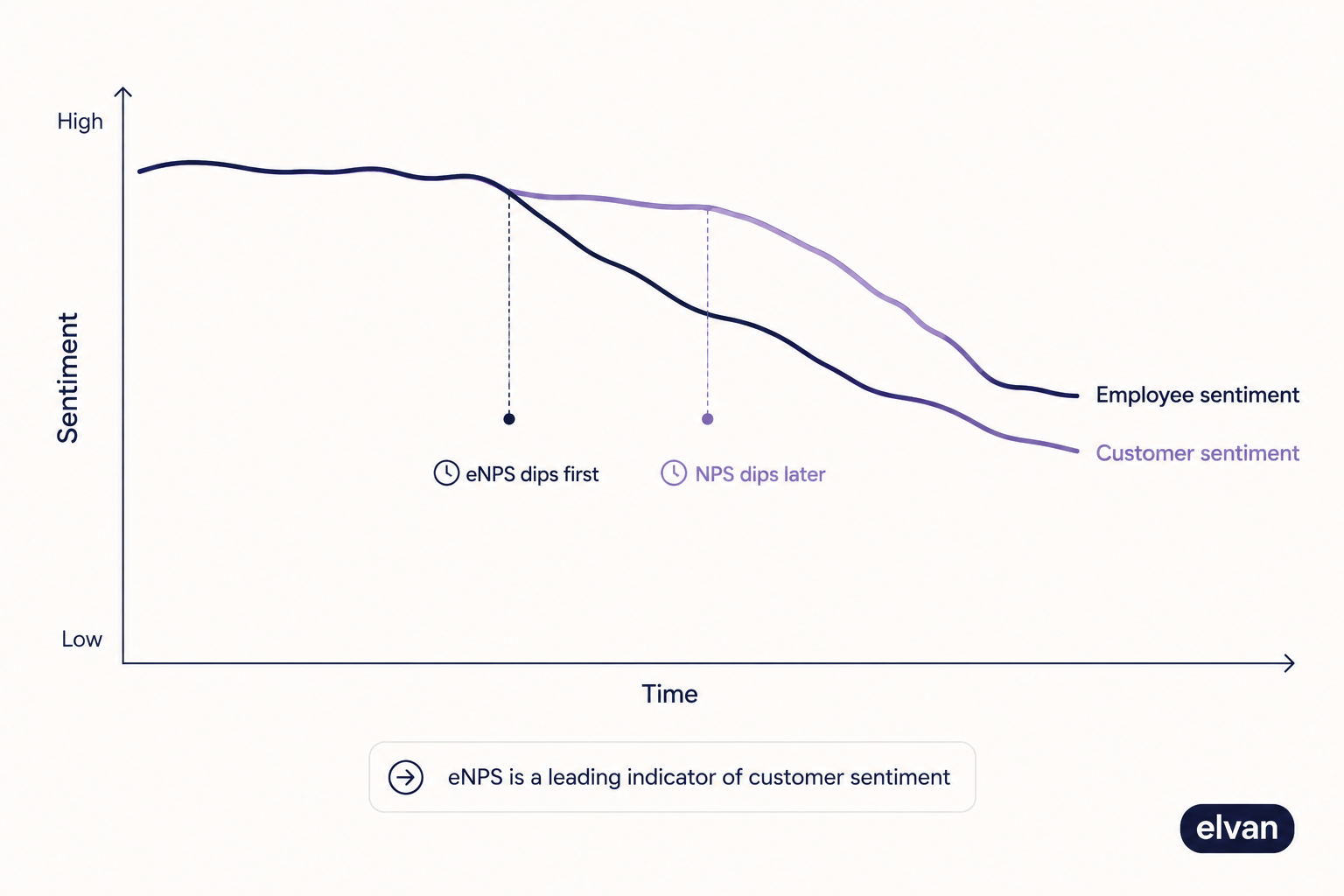
The practical implication is that ENPS is a leading indicator worth watching alongside customer NPS, not a separate HR metric in a separate silo. If your customer-facing teams' internal sentiment is sliding while customer NPS still looks fine, treat that as an early warning, not a coincidence to ignore because the customer number has not moved yet.
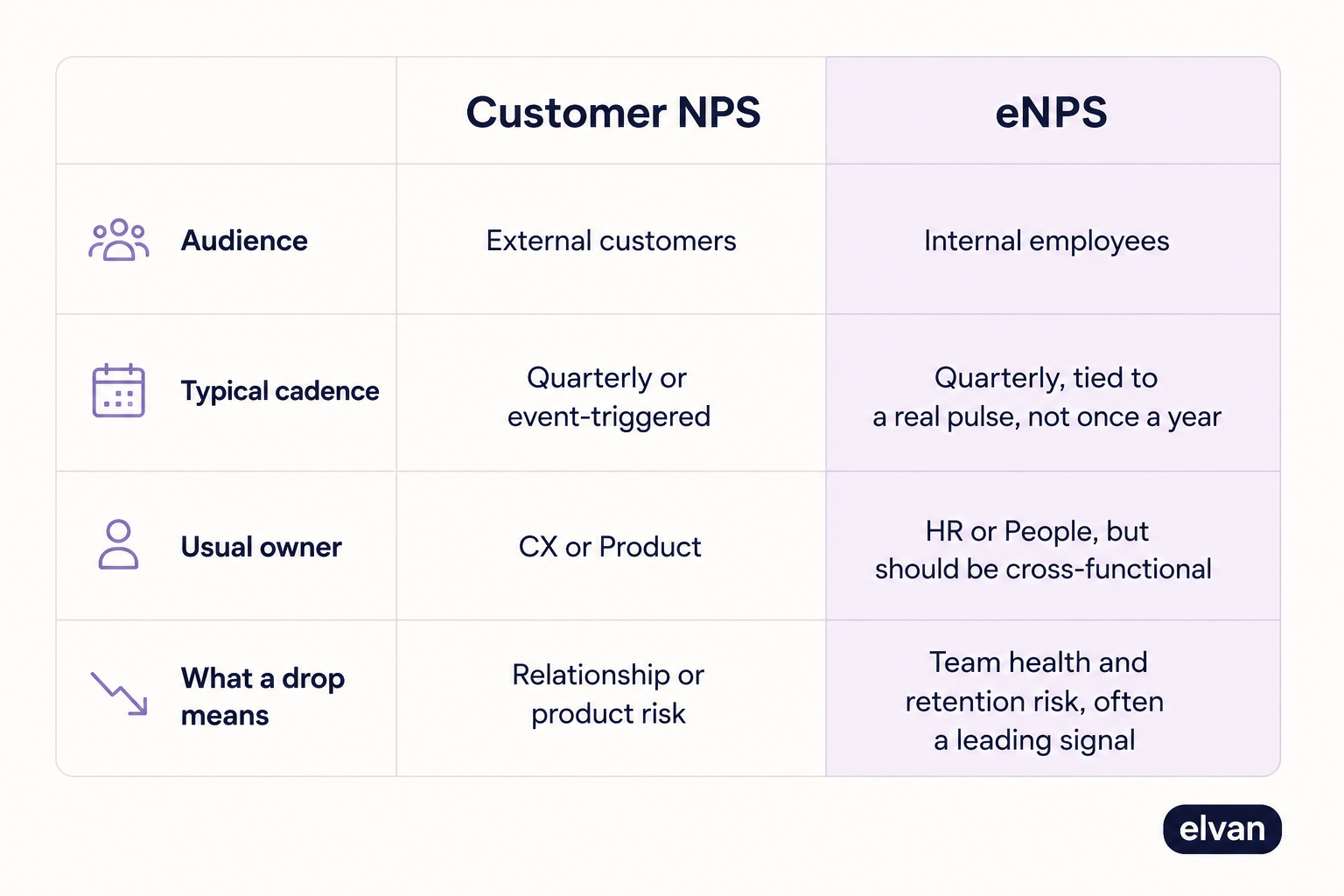
Customer NPS and ENPS side by side
The two metrics differ in audience, cadence, ownership, and what a drop actually signals, and most companies only design a program around the first one.
Running ENPS in a way that actually gets used
Ask it more than once a year. A single annual measurement cannot catch a team's morale sliding after a hard quarter, a leadership change, or a wave of departures. Quarterly, or even a short monthly pulse for smaller teams, catches the trend while it is still actionable.
Segment by team and manager, not just company-wide. A company-wide ENPS of 30 can hide one team at 60 and another at negative 10. The aggregate score tells leadership everything is fine while one manager's team is quietly falling apart.
Close the loop visibly. The fastest way to kill participation in any employee survey is to ask the question and then never mention it again. Even a short, honest update on what the last score surfaced and what changed because of it matters more than the survey design itself.
Watch it next to customer sentiment, not instead of it. Neither metric replaces the other. Together, a declining ENPS in a customer-facing team is one of the more reliable early warnings available before the customer-facing number moves.
Where Elvan fits
Elvan supports ENPS alongside NPS, CSAT, CES, and PMF from the same account, so internal and external sentiment can sit next to each other instead of living in separate tools that never get compared. AI Insights summarizes the open-text responses in plain English, useful for a People team that does not have a dedicated analyst reading every comment by hand.
If ENPS has been an annual afterthought at your company, the fix is not a bigger survey. It is a smaller one, asked more often, and actually looked at.

Neil Roy
Content Strategist
Neil is a content strategist specializing in CSAT and NPS surveys, creating educational content that helps businesses understand and improve customer satisfaction. With 10+ years of experience, Neil writes insightful articles and develops content strategies that translate complex survey concepts into accessible, actionable guidance for organizations looking to enhance their customer relationships and business outcomes.