

What Every Founder Should Know About eNPS (and How to Actually Improve It)
The fastest way to build a strong company is to build a team that actually loves showing up every day. That’s what eNPS helps you measure.
Most of us, as founders, think we know how our people feel. We read the vibe in meetings, notice who’s smiling on calls, and assume everything’s fine. Until someone great leaves, or worse, the energy quietly drops across the team.
That’s when I realized I needed something simple and consistent to measure how engaged my team really was. That’s where eNPS (Employee Net Promoter Score) came in.
It’s a straightforward, reliable way to understand how your employees truly feel about working with you. And it starts with just one question.
What Is eNPS (and Why It Matters)
eNPS stands for Employee Net Promoter Score.
It’s based on the same idea as customer NPS, except instead of asking customers if they’d recommend your product, you ask your team:
“How likely are you to recommend our company as a great place to work?”
They answer on a scale of 0 to 10, and those responses reveal how connected they feel to your mission and culture.
Here’s how the scoring works:
- Promoters (9–10): Love their work and proudly recommend your company.
- Passives (7–8): Content, but not deeply engaged.
- Detractors (0–6): Unhappy, frustrated, or disengaged.
Why You Should Track eNPS
When I first tried eNPS, I expected a number. What I got was a mirror.
Here’s what makes this metric worth your time:
1. You measure real engagement, not just surface satisfaction.
A high eNPS tells you people are genuinely proud to work here, not just staying for the paycheck.
2. It shows you what to fix.
The score itself is just a signal. When you follow up with “What’s one thing we could do better?”, you uncover actionable feedback you can actually use.
3. It improves retention and hiring.
When employees love where they work, they stay longer and refer better people. That compounds.
4. It connects to customer experience.
Teams that score high on eNPS almost always score high on customer satisfaction. Happy people make better products and deliver better service.
And best of all, it’s simple to implement. With Elvan, you can run an eNPS survey, get your score, and instantly see key insights — all in a few clicks.
How to Measure and Calculate eNPS
The math is easy:
eNPS = % of Promoters – % of Detractors
If you survey 100 employees and 60 are promoters, 25 are passives, and 15 are detractors, your eNPS is 60 – 15 = +45.
Scores range from -100 to +100. The higher, the better.
But don’t stop at the number. Ask why people gave that score.
That’s where you’ll find the context that drives meaningful action.
Elvan automatically groups open-ended responses into themes like communication, leadership, or workload, so you can spot patterns at a glance instead of manually reading through hundreds of comments.
What’s a Good eNPS Score?
There isn’t one universal benchmark, but here’s a general guide that’s worked for various companies:
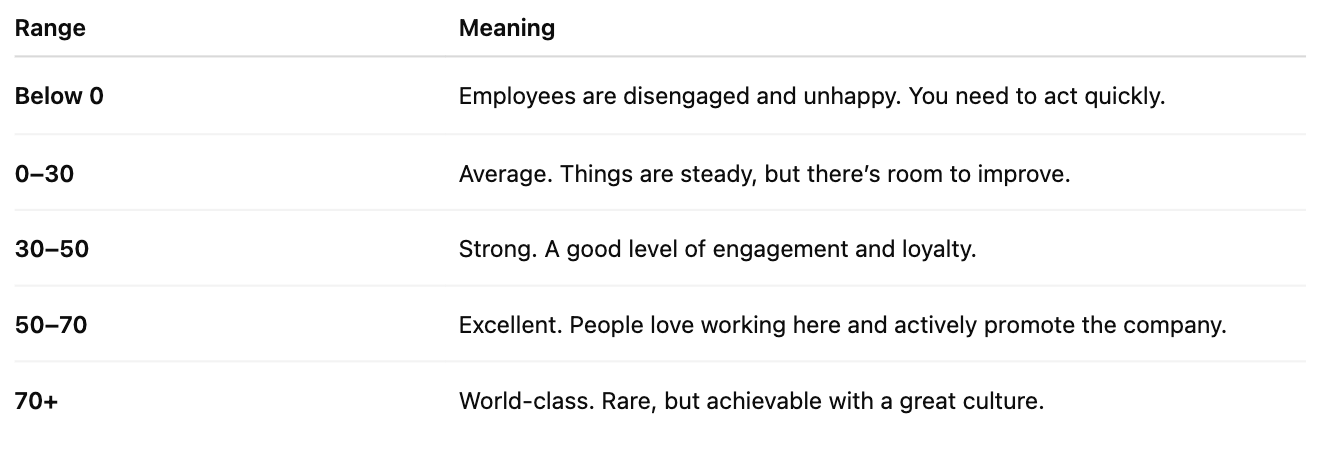
For context, here are some reported eNPS scores from real companies:
These numbers help put things in perspective. Your goal isn’t to copy them, but to continuously improve your own trend over time.
When to Measure eNPS
You don’t need to run eNPS every month. The key is consistency and timing.
Here’s what I’ve found works best:
- Quarterly surveys: Frequent enough to track change, not too often to cause fatigue.
- After big events: Policy changes, leadership updates, or product launches.
- During onboarding: Capture how new hires feel after 30 or 60 days.
- After departures: Combine with exit interviews for better context.
Once you set a rhythm, your team starts expecting it. They know their voice matters, and that makes participation skyrocket.
Best Practices for Running eNPS Surveys
Getting useful feedback isn’t about fancy questions. It’s about how you run the process.
1. Keep it anonymous.
People only speak honestly when they trust their identity is safe. Every survey I run through Elvan guarantees that.
2. Be transparent about why you’re asking.
Let your team know the goal is to learn, not to judge.
3. Share the results.
After each round, share the score, summarize feedback, and outline what you’ll improve. Even if the feedback stings, openness builds credibility.
4. Look for trends, not one-time spikes.
Compare results across departments or time periods. Progress matters more than perfection.
5. Always close the loop.
The biggest mistake I’ve seen is collecting feedback and doing nothing with it.
If people say communication is poor, address it publicly and act quickly.
How to Actually Improve eNPS
Here’s what’s worked for me and other founders I’ve spoken with:
1. Fix the fundamentals.
Don’t start with culture slogans. Start by improving clarity, communication, and recognition. People care most about being seen and supported.
2. Turn detractor feedback into priorities.
When multiple people mention the same frustration, treat it as a project.
If “lack of growth” comes up often, improve mentorship or career paths.
3. Celebrate promoters.
The happiest people in your company are your best culture ambassadors. Recognize them publicly and give them space to shape onboarding or internal culture.
4. Keep measuring.
Culture shifts over time. Keep eNPS as a recurring habit, not a one-off campaign. I do it quarterly through Elvan, and even a small improvement feels like a big win.
Limitations of eNPS (and How to Overcome Them)
No single metric tells the whole story. eNPS is powerful, but it has limits.
1. It’s just one number.
It won’t tell you why people feel the way they do.
Always pair it with open-ended feedback.
2. It can be biased.
Timing, recent changes, or small sample sizes can skew results.
Run surveys regularly and focus on trends.
3. It doesn’t capture everything.
eNPS measures advocacy, not day-to-day engagement.
Combine it with pulse surveys or manager check-ins for a fuller picture.
Used well, eNPS becomes your early-warning system — a fast, reliable way to stay connected to your team’s reality.
Final Thoughts
If you want to build a company people love working for, you have to measure how they feel.
eNPS makes that easy.
One question, a few honest answers, and you’ll see your culture more clearly than ever.
The real power isn’t in the score — it’s in what you do after you see it.
At Elvan, that’s exactly why we built our survey tool the way we did: simple to launch, easy to act on, and built to help teams grow together.
Start small. Ask the question. Listen closely.
That’s how you build a company people are proud to recommend.

Neil Roy
Content Strategist
Neil is a content strategist specializing in CSAT and NPS surveys, creating educational content that helps businesses understand and improve customer satisfaction. With 10+ years of experience, Neil writes insightful articles and develops content strategies that translate complex survey concepts into accessible, actionable guidance for organizations looking to enhance their customer relationships and business outcomes.